The Great Red Spot and other weather
Stripes made of ammonia clouds, winds faster than a racing car, cyclones in geometric patterns and a storm that has been going for centuries.
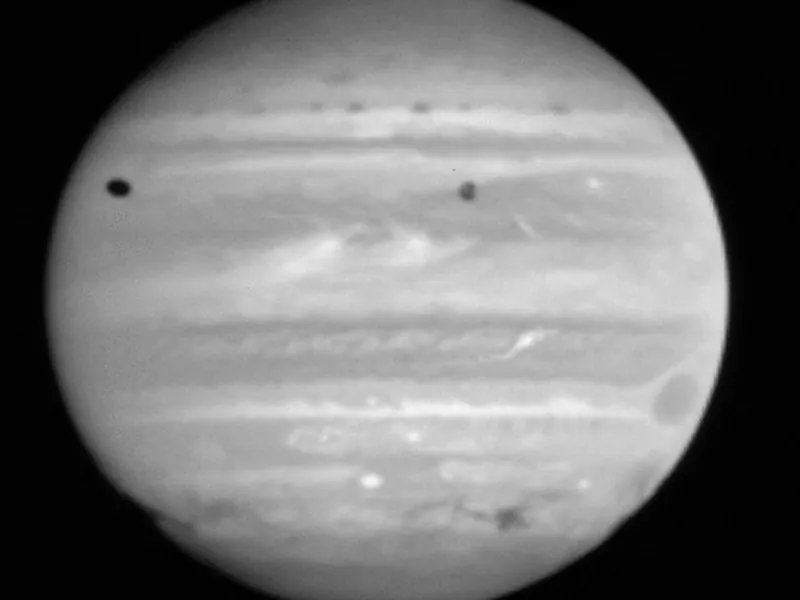
Belts and zones
The dark orange stripes are called belts and the lighter bands are zones. Their winds blow east and west in opposite directions. NASA Science: Jupiter facts Jupiter’s stripes and swirls are cold, windy clouds of ammonia and water, floating in hydrogen and helium. NASA Science: Jupiter facts
Jupiter probably has three cloud layers: ammonia ice on top, ammonium hydrosulfide in the middle, and water ice and vapour deepest down. NASA Science: Jupiter facts
Some of Jupiter’s winds reach 539 km/h at the equator. NASA Science: Jupiter facts Jupiter’s jet streams reach about 3,200 km deep. NASA Science: Jupiter facts
The Great Red Spot
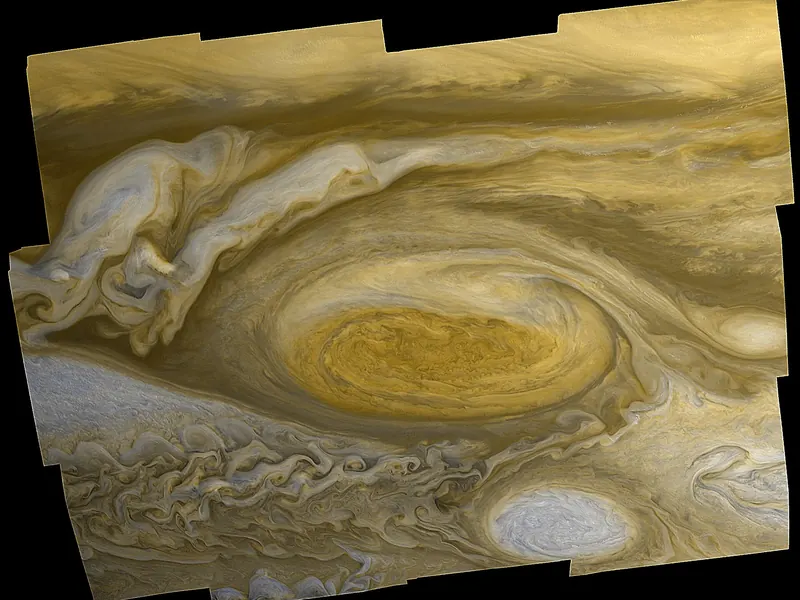
The Great Red Spot is a giant storm bigger than Earth. NASA Science: Jupiter facts
NASA’s Jupiter facts page says the Great Red Spot has been observed for more than 300 years. NASA Science: Jupiter facts · checked 27 Oct 2026 A 2024 NASA Hubble article says astronomers have observed it for at least 150 years. NASA Science: Hubble watches the Great Red Spot behave like a stress ball (2024) · checked 27 Oct 2026
Shrinking
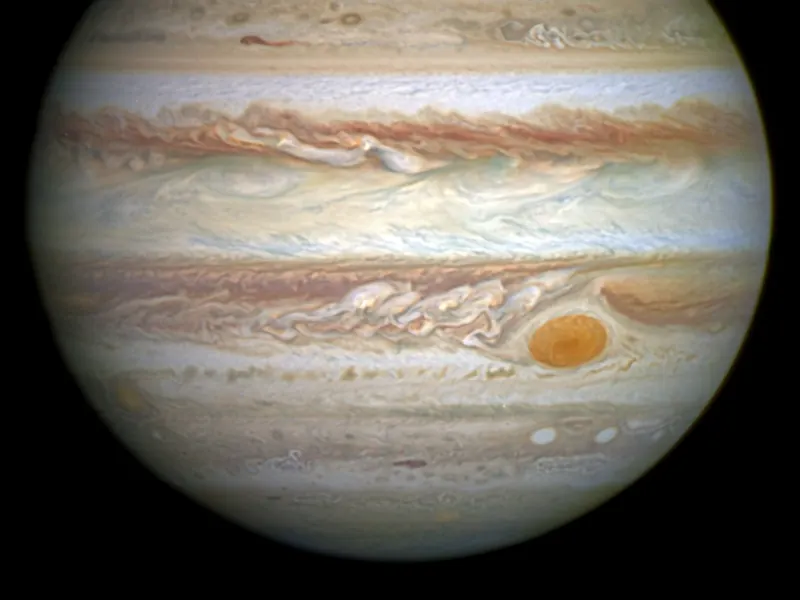
- Late 1800s Observations from the late 1800s measured the Great Red Spot as up to 25,500 miles (about 41,000 km) on its long axis. NASA Science: Jupiter’s Great Red Spot is shrinking (2014)
- 1979 Voyager 1 and 2 measured it at 14,500 miles (about 23,300 km) across in 1979. NASA Science: Jupiter’s Great Red Spot is shrinking (2014)
- 1995 A 1995 Hubble photo put its long axis at about 13,020 miles (about 20,950 km). NASA Science: Jupiter’s Great Red Spot is shrinking (2014)
- 2009 In 2009 it measured 11,130 miles (about 17,910 km) across. NASA Science: Jupiter’s Great Red Spot is shrinking (2014)
- 2014 In 2014, Hubble measured it at about 10,250 miles (about 16,500 km) across, the smallest ever measured at that time. NASA Science: Jupiter’s Great Red Spot is shrinking (2014)
Astronomers have watched the Great Red Spot shrink since the 1930s, and from 2012 it shrank faster, turning from an oval towards a circle. NASA Science: Jupiter’s Great Red Spot is shrinking (2014) · checked 27 Oct 2026
Line Earths up across it for yourself: try the storm explorer →
The jelly-wobble
Hubble watched it for 90 days in 2023–24 and saw it jiggle in size and shape, like a bowl of jelly. The cause is unknown. NASA Science: Hubble watches the Great Red Spot behave like a stress ball (2024)
Juno’s gravity data suggest the Great Red Spot reaches about 500 km below the cloud tops. NASA Science: Jupiter facts
The Little Red Spot
Three smaller ovals merged to form the Little Red Spot, about half the size of the Great Red Spot. NASA Science: Jupiter facts
Cyclones at the poles
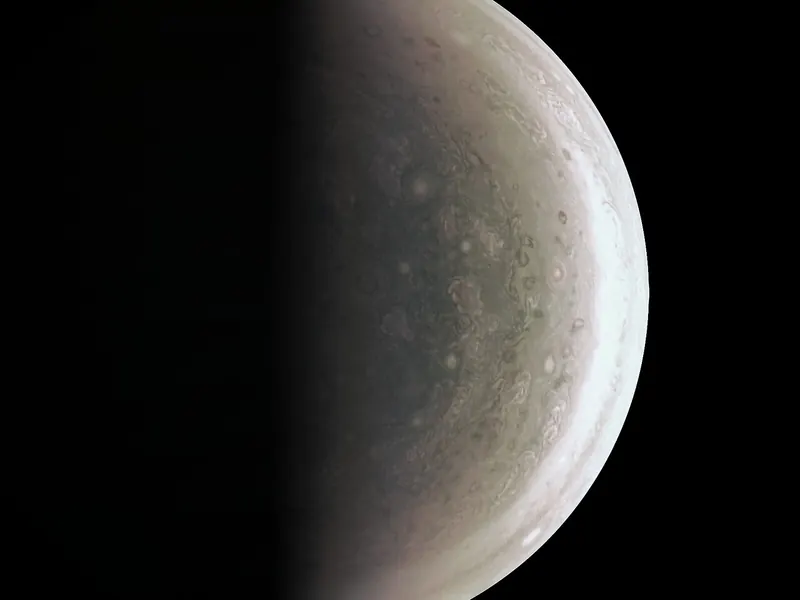
Juno found giant cyclones at Jupiter’s poles: eight in an octagon in the north and five in a pentagon in the south. NASA Science: Jupiter facts
Auroras
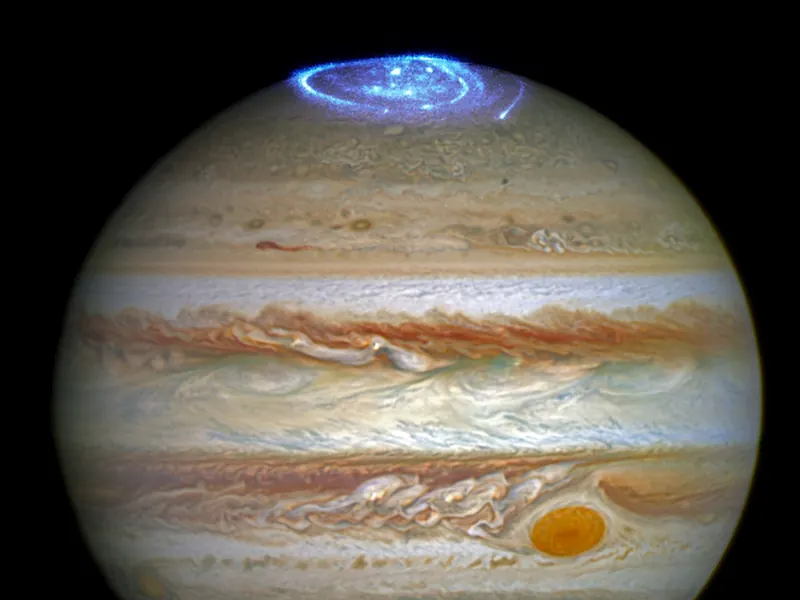
Jupiter has auroras too, hundreds of times more energetic than Earth’s. NASA Space Place: All about Jupiter
Rings
Jupiter has rings, discovered by Voyager 1 in 1979. They are dark and faint, and hard to see unless the Sun is behind them. NASA Science: Jupiter facts
When a comet hit
In July 1994, pieces of comet Shoemaker-Levy 9 smashed into Jupiter, from 16 to 22 July: the first time spacecraft watched two solar system bodies collide. NASA Science: Comet Shoemaker-Levy 9 When it was found in 1993, the comet was already torn into more than 20 pieces by Jupiter’s gravity. NASA Science: Comet Shoemaker-Levy 9
Next: moons →