Size, gravity and what’s inside
A basketball next to Earth’s grape, spinning in under ten hours, with no ground anywhere. Here’s Jupiter in numbers.
The biggest, and the oldest
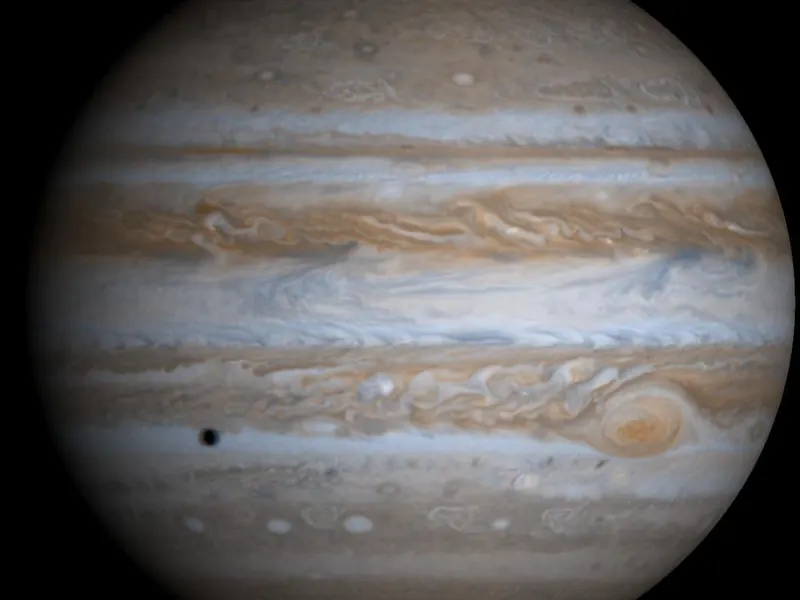
Jupiter is the fifth planet from the Sun, and the largest in the solar system by far. NASA Science: Jupiter Jupiter is the largest and oldest planet in our solar system. NASA Science: Jupiter
Jupiter formed with the rest of the solar system about 4.6 billion years ago. NASA Science: Jupiter facts
How big?
Jupiter’s mean radius is 69,911 km, so it is 11 times wider than Earth. NASA Science: Jupiter facts If Earth were the size of a grape, Jupiter would be about as big as a basketball. NASA Science: Jupiter facts
If Jupiter were a hollow shell, 1,000 Earths could fit inside. NASA Science: Jupiter Jupiter is more than twice as massive as all the other planets put together. NASA Science: Jupiter
Jupiter has 317.83 times the mass of Earth. NASA NSSDC: Jupiter fact sheet
Jupiter’s equatorial radius is 71,492 km and its polar radius is 66,854 km: it is squashed, wider round the middle. NASA NSSDC: Jupiter fact sheet
In 2026, NASA reported that Juno’s data show Jupiter is about 8 km narrower at the equator and 24 km flatter at the poles than previously thought. NASA Science: Juno redefines the size and shape of Jupiter (2026)
Jupiter’s average density is 1,326 kg per cubic metre, about a quarter of Earth’s (5,513). NASA NSSDC: Jupiter fact sheet
How far?
Jupiter orbits an average of 778 million km from the Sun: 5.2 astronomical units. NASA Science: Jupiter facts Sunlight takes 43 minutes to travel from the Sun to Jupiter. NASA Science: Jupiter facts
Jupiter comes as close as 588.5 million km to Earth, and gets as far as 968.5 million km away. NASA NSSDC: Jupiter fact sheet
Days and years
Jupiter has the shortest day in the solar system: it spins once in about 9.9 hours. NASA Science: Jupiter facts A day on Jupiter (sunrise to sunrise) lasts 9.9259 hours. Earth’s lasts 24 hours. NASA NSSDC: Jupiter fact sheet
Jupiter takes 4,332.589 Earth days to orbit the Sun once: about 12 Earth years. NASA NSSDC: Jupiter fact sheet A year on Jupiter is about 12 Earth years (4,333 Earth days). NASA Science: Jupiter facts
Jupiter is tilted by just 3 degrees, so it spins nearly upright and doesn’t have big seasons. NASA Science: Jupiter facts
How old would you be in Jupiter years? Try “You on Jupiter” →
Gravity, and nowhere to stand
Gravity at Jupiter’s 1-bar cloud level averages 25.92 m/s², 2.640 times Earth’s 9.82 m/s². NASA NSSDC: Jupiter fact sheet
To escape Jupiter’s gravity you’d need 59.5 km per second. From Earth it’s 11.19. NASA NSSDC: Jupiter fact sheet
Jupiter has no true surface. It is mostly swirling gases and liquids, so a spacecraft would have nowhere to land. NASA Science: Jupiter facts The pressures and temperatures deep inside Jupiter would crush, melt and vaporise a spacecraft trying to fly in. NASA Science: Jupiter facts
Air and temperature
Jupiter’s atmosphere is about 89.8% hydrogen and 10.2% helium. NASA NSSDC: Jupiter fact sheet Like the Sun, Jupiter is made mostly of hydrogen and helium. NASA Science: Jupiter facts
At the level where the pressure equals Earth’s sea level (1 bar), Jupiter’s air is about −108 °C. NASA NSSDC: Jupiter fact sheet
Jupiter has the same ingredients as a star, but it never grew massive enough to ignite. NASA Science: Jupiter facts
Inside Jupiter
Deep down, pressure squeezes hydrogen gas into a liquid, giving Jupiter the largest ocean in the solar system: an ocean of hydrogen, not water. NASA Science: Jupiter facts Deeper still, the liquid hydrogen may become electrically conducting, like a metal. NASA Science: Jupiter facts
Juno’s measurements suggest Jupiter’s core is larger than expected and not solid: scientists call it dilute, or “fuzzy”. NASA Science: Jupiter facts
A giant magnet
Jupiter’s magnetic field is 16 to 54 times as powerful as Earth’s. NASA Science: Jupiter facts Jupiter’s magnetosphere stretches into a tadpole-shaped tail more than 1 billion km long, as far as Saturn’s orbit. NASA Science: Jupiter facts
Its name
Jupiter is named after the king of the gods in Roman mythology. NASA Science: Jupiter facts Most of Jupiter’s moons are named after characters from mythology linked to Jupiter or his Greek counterpart, Zeus. NASA Science: Jupiter facts
Jupiter has been known since ancient times: you can see it with just your eyes. NASA Space Place: All about Jupiter The first detailed observations of Jupiter were made by Galileo Galilei in 1610, with a small, homemade telescope. NASA Science: Jupiter
Could anything live there?
Jupiter itself is probably too extreme for life as we know it, but some of its moons may not be. NASA Science: Jupiter facts
Most Jupiter numbers here come straight from NASA’s Jupiter facts page and NASA’s Jupiter fact sheet. Sometimes NASA pages disagree, and when they do we show both rather than pick one quietly. Moons: NASA’s Jupiter facts page says 115 are officially recognised, while the older NASA satellite fact sheet still says 95. The Great Red Spot’s age: “more than 300 years” on one NASA page, “at least 150 years” on another. Counts and mission news change, so they carry the date we checked them.
Next: storms →