Things everybody “knows” about Jupiter
A failed star, somewhere to land and four moons exactly. Gently corrected.
Myth Jupiter is a star that never got going, so it’s nearly a star.
Fact Jupiter has the same ingredients as a star, but it never grew massive enough to ignite. NASA Science: Jupiter facts Jupiter has 317.83 times the mass of Earth. NASA NSSDC: Jupiter fact sheet
Myth You could land on Jupiter if you were brave enough.
Fact Jupiter has no true surface. It is mostly swirling gases and liquids, so a spacecraft would have nowhere to land. NASA Science: Jupiter facts The pressures and temperatures deep inside Jupiter would crush, melt and vaporise a spacecraft trying to fly in. NASA Science: Jupiter facts
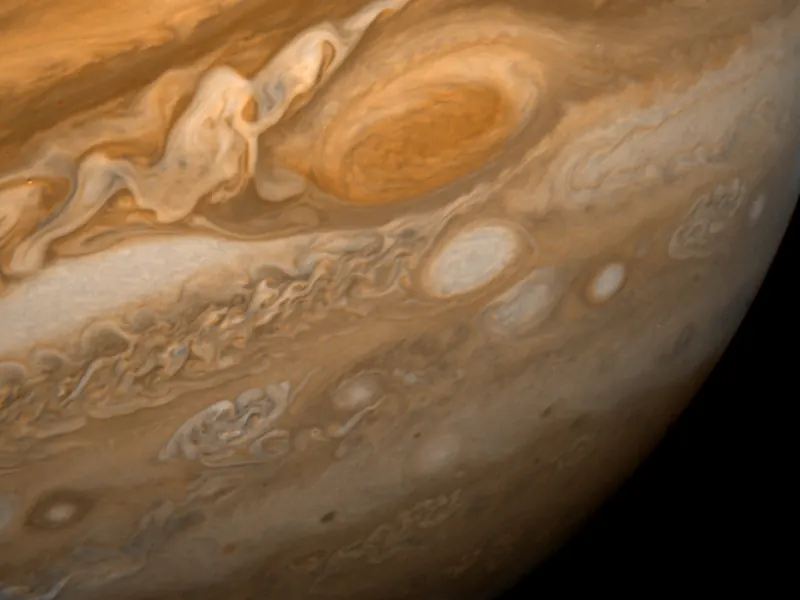
Myth The Great Red Spot never changes.
Fact Astronomers have watched the Great Red Spot shrink since the 1930s, and from 2012 it shrank faster, turning from an oval towards a circle. NASA Science: Jupiter’s Great Red Spot is shrinking (2014) · checked 27 Oct 2026 Hubble watched it for 90 days in 2023–24 and saw it jiggle in size and shape, like a bowl of jelly. The cause is unknown. NASA Science: Hubble watches the Great Red Spot behave like a stress ball (2024)
Myth Only Saturn has rings.
Fact Jupiter has rings, discovered by Voyager 1 in 1979. They are dark and faint, and hard to see unless the Sun is behind them. NASA Science: Jupiter facts
Myth Jupiter has four moons.
Fact Jupiter has 115 moons officially recognised by the International Astronomical Union. NASA Science: Jupiter facts · checked 27 Oct 2026 The four largest moons, Io, Europa, Ganymede and Callisto, were first seen by Galileo Galilei in 1610. They are called the Galilean satellites. NASA Science: Jupiter moons
Myth Our Moon is the biggest moon in the solar system.
Fact Ganymede is the largest moon in the solar system, bigger than the planet Mercury and the dwarf planet Pluto. NASA Science: Ganymede facts
Myth Jupiter’s stripes are painted on its surface.
Fact Jupiter’s stripes and swirls are cold, windy clouds of ammonia and water, floating in hydrogen and helium. NASA Science: Jupiter facts The dark orange stripes are called belts and the lighter bands are zones. Their winds blow east and west in opposite directions. NASA Science: Jupiter facts
Myth Big planets must spin slowly.
Fact Jupiter has the shortest day in the solar system: it spins once in about 9.9 hours. NASA Science: Jupiter facts
Myth Nothing ever hits Jupiter.
Fact In July 1994, pieces of comet Shoemaker-Levy 9 smashed into Jupiter, from 16 to 22 July: the first time spacecraft watched two solar system bodies collide. NASA Science: Comet Shoemaker-Levy 9
Myth All oceans are made of water.
Fact Deep down, pressure squeezes hydrogen gas into a liquid, giving Jupiter the largest ocean in the solar system: an ocean of hydrogen, not water. NASA Science: Jupiter facts